

{:en}PRESS RELEASE (5/17/2017)
Saturday, May 20, Loano will take a dip into the past with the Renaissance Festival which will reenact the Proclamation of Loano as an independent county occurred in the 1575 in the presence of Loano Counts Gianandrea Doria and Zenobia Del Carretto Doria.
The initiative, promoted by the’Department of Tourism, Culture and Sports of the City of Loano and organized by the’Pro Musica Antiqua Association with the contribution of the A. Foundation De Mari, will kick off at 4 p.m..
...I was born in the year of 1540, and of eight years the Prince my Lord led me with him, and continually made me on all occasions s'offerero, sail with him. Of fourteen years he sent me chief of many galleys and of fifteen years of all the Generals of the King our Lord....
So begins the ’Autobiography” of Prince Giovanni Andrea Doria (1540-1606) whose adventurous life, saddened when he was only seven years old by the tragic death of his young father Giannettino, who was killed in the turmoil of the Fieschi Conspiracy of 1547, was as he himself recounts immediately directed to the sea by the favor, and the will, of the great Admiral Andrea Doria.
John Andrew had a very close relationship with Loano beginning in 1575 when the fiefdom-which had belonged to the Dorias for centuries and had been sold to the Fieschi in the early sixteenth century under controversial circumstances-returned to the family's domains and elevated to county status.
This was a very important episode for Loano, which from that moment experienced a new golden age, later confirmed by Giovanni Andrea's descendants. The “Renaissance Feast” wants to recreate a little of the atmosphere of those days, starting with the central characters, namely Giovanni Andrea and his beloved consort Zenobia Doria Del Carretto, princess of Melfi, a lady of great prestige and moral and religious caliber (qualities that were recognized by St. Charles Borromeo himself, who also for this reason approved the marriage of his grandchildren Vittoria Colonna and Don Ferrante Gonzaga with the children of the Doria princes) and, above all, very attached to Loano.
In an ideal and evocative journey through time, Gianandrea and Zenobia will return to their ancient palace, accompanied by the noblemen and ladies of their retinue and escorted by a squadron of armed men. During the procession that will cross the streets of the village as far as Porta Passorino, by the way, precisely dating back to Gianandrea's time, and in the subsequent moments that will have Piazza Italia and the Palazzo Doria as their backdrop, episodes related to the history of Loano and the epic of the Doria princes will be reenacted, based on original documents.
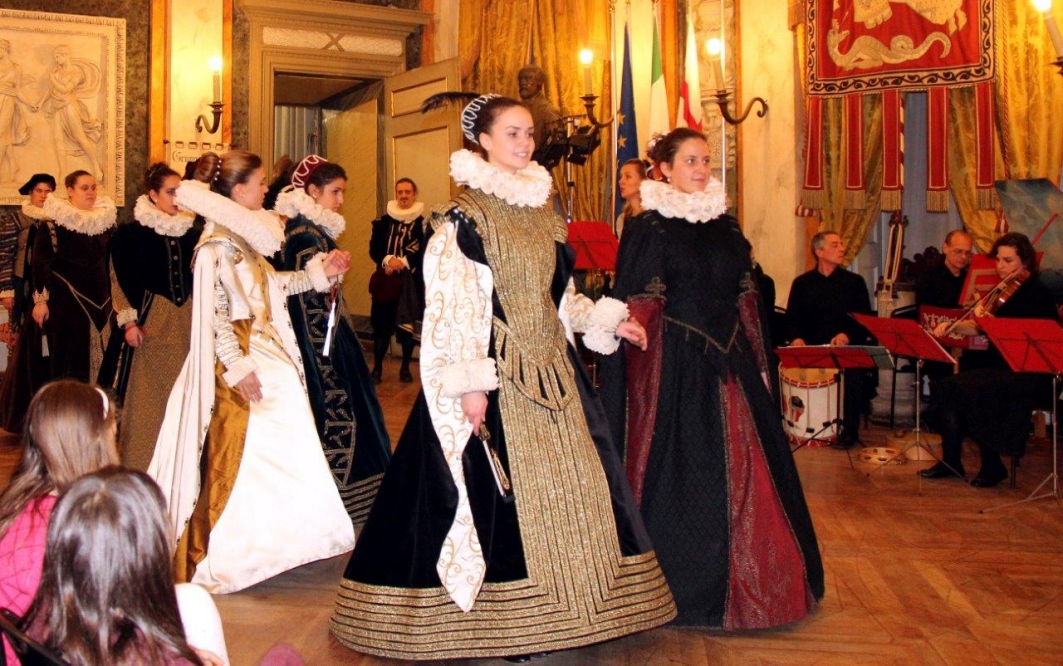
The reenactment will begin with maneuvers e military honors and salvos of arquebuses and will culminate with a performance of music and dance in honor of Princess Zenobia and Prince Gianandrea: an essay of the grand reception which the prince himself, on July 29, 1571, offered in his palace at Fassolo in Genoa to Don Giovanni D'Austria and his captains, about to leave for Lepanto. On that occasion, writes dance master Cesare Negri in his 1602 treatise “The Graties of Love“, “a banquet was held in Genoa à fifty-two
Ladies of the principal ones of the city, all dressed in ermesino, and white satin, and adorned with beautiful jewels. And it was served to eighteen plates, then a great feast was made....”
Starring in what is meant to be a small tribute to the early history of Loano will be the musicians of the’Pro Musica Antiqua Association, the historical dance group The Graties of Love (who will use clothing provided by the Cerratelli Foundation of Pisa for the occasion) and the company of arms Flos Duellatorum. The historical procession and music and dance performance will be attended by the’Sandro Pertini High School's trumpet ensemble of Genoa, the group of Dominae Naulensis of Noli and the historical group of the Campanassa of Savona, which, in particular, will testify to the medieval part of the Doria presence in Loano at the time of Oberto and especially Raffo Doria, under whose rule the first settlements appeared in the area by the sea.
PROGRAM
4 p.m. – Italy Square
Proclamation of the establishment of the independent county of Loano
4:30 p.m.- streets of the historic center
Historical parade
Italy Square
hours 17.00 - Military maneuvers in honor of the House of Doria with the presence of nobles, gunmen and salvoes of arquebuses.
hours 17.30/19.00 - “Grand show of singing music and dancing in the square”
GROUPS.
The Graties of Love of Lavagna (Genoa): created in the context of the medieval re-enactment of the Lavagna Fieschi Cake, since 1986 they have been reconstructing dances, clothing and settings from medieval and Renaissance times, based on precise period documentation. In 2004 they promoted some prestigious events in the context of Genoa European Capital of Culture, in particular by reconstructing and presenting at Palazzo Ducale and Palazzo Spinola di Pellicceria the dresses and dances inspired by Van Dyck and Rubens portraits of the noblewomen Paolina Adorno Brignole Sale, Caterina Balbi Durazzo and Brigida Spinola Doria. In 2011, a collaboration began with the Cerratelli Foundation in Pisa, which preserves, among others, stage dresses from Zeffirelli's films, from the Romeo and Juliet at Taming of the Shrew a Brother Sun Sister Moon. In 2015, he was called by the City of Genoa to Expo Milan to represent with dances, music and costumes the “siglo de Oro,” the golden age of Genoese art, politics and economy at the turn of the 16th and 17th centuries. In 2016, the group participated, exhibiting documents and costumes, in the “La Bella Italia” festival at the Tzaritzino State Museum in Moscow, under the patronage of the Ministry of Culture of the Russian Federation and the Italian Cultural Institute in Moscow.
Flos Duellatorum of Lavagna-Chiavari (Genoa): one of Italy's oldest companies of arms, originating from the experiences in the 1950s of the ’fencers“ active at the Torta dei Fieschi in Lavagna, was formed in the 1980s and officially in 1985 by reconstructing duels and military techniques inspired by the 15th-century treatise by Fiore de” Liberi da Premariacco, which gives the company its name. Over the years, the FLos Duellatorum has expanded its activities and its range of reenactment proposals: from the Communis Ianuensis Company inspired by the 13th century and reconstructing the civil and military life in medieval times of the Commune of Genoa, its domains, and its allies, to the 16th century with the Battalion Course 1625, dedicated to combatants in the service of the Republic of Genoa, and the Carignano Regiment Salieres established by the Savoy in 1636, passed to France in 1659 and transferred to Canada in 1664 to defend the French colonies in North America. Other projects concern the Napoleonic epic (“Imperial Gendarmerie“) and the Roman military events of the 6th century (“Numerus Italorum”)
The Association “Pro Musica Antiqua” aims at the preservation and popularization of historical, cultural and artistic heritage, especially musical heritage. The group consists of musicians who use ancient instruments such as: dulciana, bombard, cornetto, flute, encapsulated reed instruments, viella, viola and other stringed instruments, percussion, theorbo, harpsichord, portative organ, (strictly all copies of original instruments). It also consists of singers specializing in early music and a historical dance group. Concerts and performances are made following as closely as possible the principles of philology and performance practice of the period.
{:}