

PRESS RELEASE (23/06/2015)
Wednesday, June 24, a Loano, the traditional religious festival of St. John the Baptist.
At 8:30 pm, by Italy Square will start the procession that will go through the streets of the center accompanied by the notes of the’S.M. Immaculate Music Association.
L’Origin of the cult of St. John the Baptist at Loano dates back to the early Middle Ages; in fact, a parchment dated A.D. 775 contains a deed of gift from Emperor Charlemagne to the Benedictine monks of St. Peter in Varatella, which among various provisions states: Etiam in loco qui Lovanus vocatur, una cum Plebe in honorem S. Mariae, et S. Ioannis,......
This valuable document shows that not only was Loano already established in the parish, but it recognized St. John the Baptist among its patrons.
Around the year one thousand, the Monks of St. Peter in Varatella had founded in Loano a monastery of Benedictine nuns under the title of St. John, as recorded in the 1257 brief of Pope Alexander IV to the Bishop of Albenga concerning its suppression.
The church of this monastery, which has been modified and rebuilt several times, is the current Oratory of St. John the Baptist home of the Confraternity of the same name whose founding can be traced back to 1262.
In 1263 the Bishop of Albenga Lanfranco di Negro sold Loano to Oberto Doria Admiral of Genoa, thus began a long history between Loano and Genoa, between the Confraternity of the Disciplinants and the Dorias whose only point of contact was St. John the Baptist and his Ashes.
The strengthening and spread in Genoa and more generally in Liguria of the cult of the Baptist is surely linked to the presence in the cathedral of San Lorenzo of his ashes.
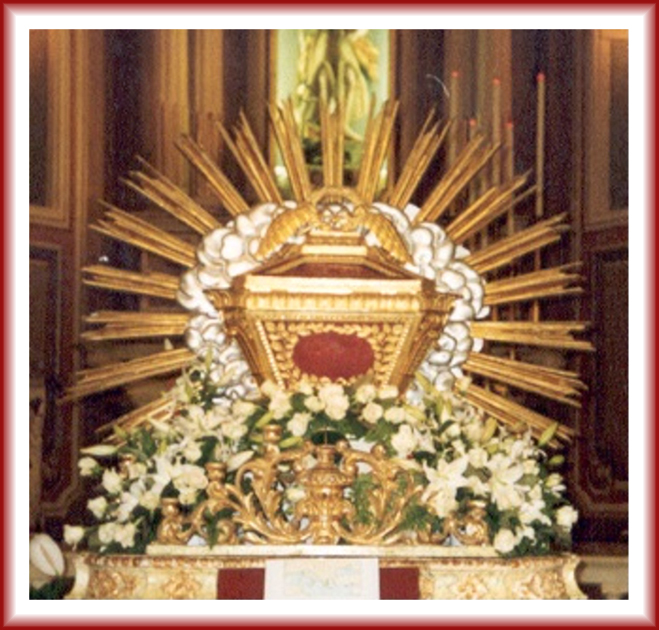
As far as concerns the small portion of the Ashes of St. John the Baptist preserved in Loano, the Confraternity of the Whites came into possession thanks to the Doria Princes who, wishing to ingratiate themselves with the hostile Confraternity of the Disciplinants, managed to obtain from the Archbishop of Genoa a portion of the Ashes so that they could be kept in the oratory of St. John the Baptist.
They are still preserved in two ancient urns, authenticated with bishop's seals, and are carried in procession on the feast of St. John the Baptist on June 24, as is also the case in the city of Genoa.