

PRESS RELEASE (11/12/2014)
Saturday, December 13, a Loano, at 3 p.m, at Council Chamber (Palazzo Doria)a conference will be held to present the “restoration work on the St. Sebastian Bridge”.
The initiative, organized by the’UNITRE of Loano under the auspices of the Municipality of Loano, will see the presence of the Mayor of Loano Luigi Pignocca, of the Councillor for Culture Remo Zaccaria and the Loano historian Antonio Arecco.
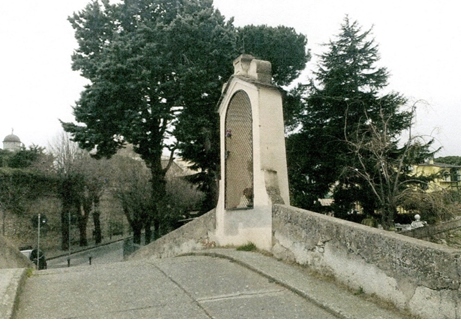
“The design hypothesis for the rehabilitation and preservation of the bridge's historic and valuable structures," explains the Mayor of Loano Luigi Pignocca - developed with a view to preserving, for this artifact and thus for the entire city of Loano and its citizens, an identity of its own, rich in popular values, and a connection with the past. Along these lines, the idea of reconstructing the shrine of the Saint as it was before the collapse fits in.”
The planned interventions concern first of all the arched supporting structure, which will undergo maintenance, rehabilitation and conservation works. Also planned is the cortical cleaning of the wall face of the parapets from vegetation, with the recovery and integration of small breaches or cuci and scuci lesions and repointing of the joints with lime mortar. The rubble masonry will be rebuilt by salvaging the collapsed material or by using brick bricks walled with lime mortar and anchored to the bridge structure with iron reinforcing chunks. The current existing concrete beaten sidewalk and associated sidewalks will be replaced with architectural concrete pavement, using “native” materials as inert.
“The newsstand," explains Councillor Remo Zaccaria - will be faithfully reconstructed.The statue of St. Sebastian, made of Finale snail stone, dates back to the 1930s and was donated in 1934 by Mrs. Luce Borsarelli, wife of the then podestà to replace the previous one that was lost. The bridge “du niciu” (bridge of the niche), dedicated to St. Sebastian, was built in 1691 to allow passage over the Nimbalto stream from the back of the Doria palace so as to unite the walled Borgo with the Borgo Castello. The current state of the bridge conforms to its nineteenth-century state, except for the two small sidewalks at the base of the parapets, which historical records indicate date back to the 1950s. The bridge restoration project includes lighting the arch of the bridge with a state-of-the-art projector of the “LED” type and lighting the wayside shrine with recessed spotlights.”